Showing posts with label 02. Show all posts

02 Exemplars

Kiefer Showroom - Technic Showroom
The dynamic facade is an example of how mobile and flexible can be incorporated into the building.


David Bley and Gabriel Aguilar
Inspiration light paintings.  Could this be a virtual platform?

Andrew Maynard - Suburb Eating Robot
Mobile and distributed solution to issues of urban sprawl
Fulton & Saloman
Flexible uses of shipping containers
Archigram
Plug in city, walking city
Antman Goresetman Architects
Mobile Initiative Pavilion

02 TED Talk - Using Nature's Genius in Architecture

Further research on distributed architecture. Here, Michael Pawlyn talks about biomimicry which has inspired a new approach to design.
"...talking about the linear to closed loop idea.  The way we tend to use resources is we extract them, we turn them into short-life products and then dispose of them.  Nature works very differently.  In ecosystems, the waste from one organism becomes the nutrient for something else in that system."

02 Australia's perceptions of their National Capital

The 2008 study, Australia's perceptions of their National Capital was examined to answer the questions raised during the Parliament discussion. The key findings summarised in the 2008 study were;


  • 70.6% of respondents' first impressions/images of Canberra were associated with politicians/parliaments followed by national capital/ACT
  • The majority of respondents identified parliament house and the Australian War Memorial as the attraction or event of most significance in Canberra
  • Respondents strongly agreed that Canberra has a political focus (64.6%)
  • Approximately 56% of respondents agreed that Canberra reflects national values, while 72.3% agreed or strongly agreed that Canberra reflects Australia's defence forces, democracy (69.9%) and Australian history (66.9%)


Positive perceptions of Canberra outweigh negative.
The study also addressed that those misinformed and uniformed generally have negative views of Canberra.

From this study, it may not be necessary to change the image of Canberra and Parliament.  Instead, focus could be directed toward designing 'agents' for Parliament to assist with issues or management.

02 Parliament in the 21st Century

This reading follows the discussion re. the relevance of Parliament.  What role does architecture play in facilitating the progression of political responsibilities?


Parliament in the 21st Century
Halligan., J. R, Miller. J, Power.
[extract p10-11]
Apart from the doubtful relevance of nineteenth-century ideals, there has still been the fundamental issue of a growing imbalance within the structure of government. There were two main reasons for this. The first is the role of the political party. Since the rise of disciplined political parties in the first decade or so of the twentieth century, parliament’s character has changed. It is no longer a forum for individual politicians to support concerns of their constituents. 

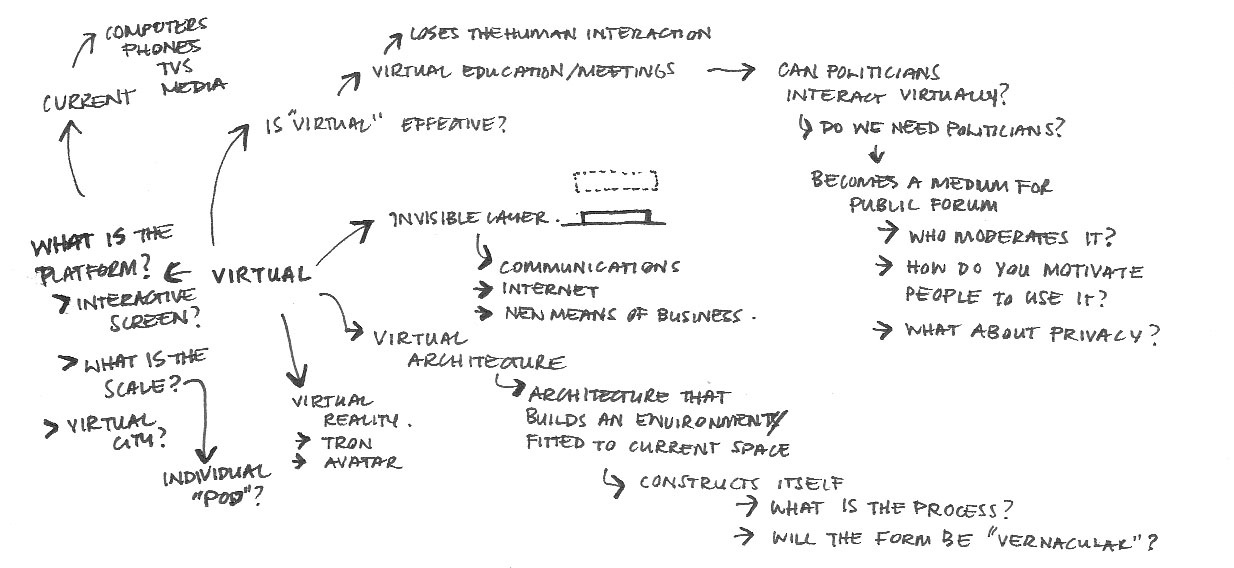
02 Virtual